Cursor vs Blackbox AI
Detailed comparison of Cursor and Blackbox AI — pricing, features, pros and cons.
The Challenger
Blackbox AI
Best for AI Coding
The Quick Verdict
The choice between Cursor and Blackbox AI in 2026 depends entirely on your development philosophy and workflow. The choice between Cursor and Blackbox AI in 2026 depends entirely on your development philosophy and workflow.
Independent Analysis
Feature Parity Matrix
| Feature | Cursor from $20/mo | Blackbox AI |
|---|---|---|
| Pricing model | freemium | freemium |
| free tier | ||
| api access | ||
| ai features | ||
| integrations | VS Code extensions |
Cursor vs. Blackbox AI: A 2026 Deep Dive
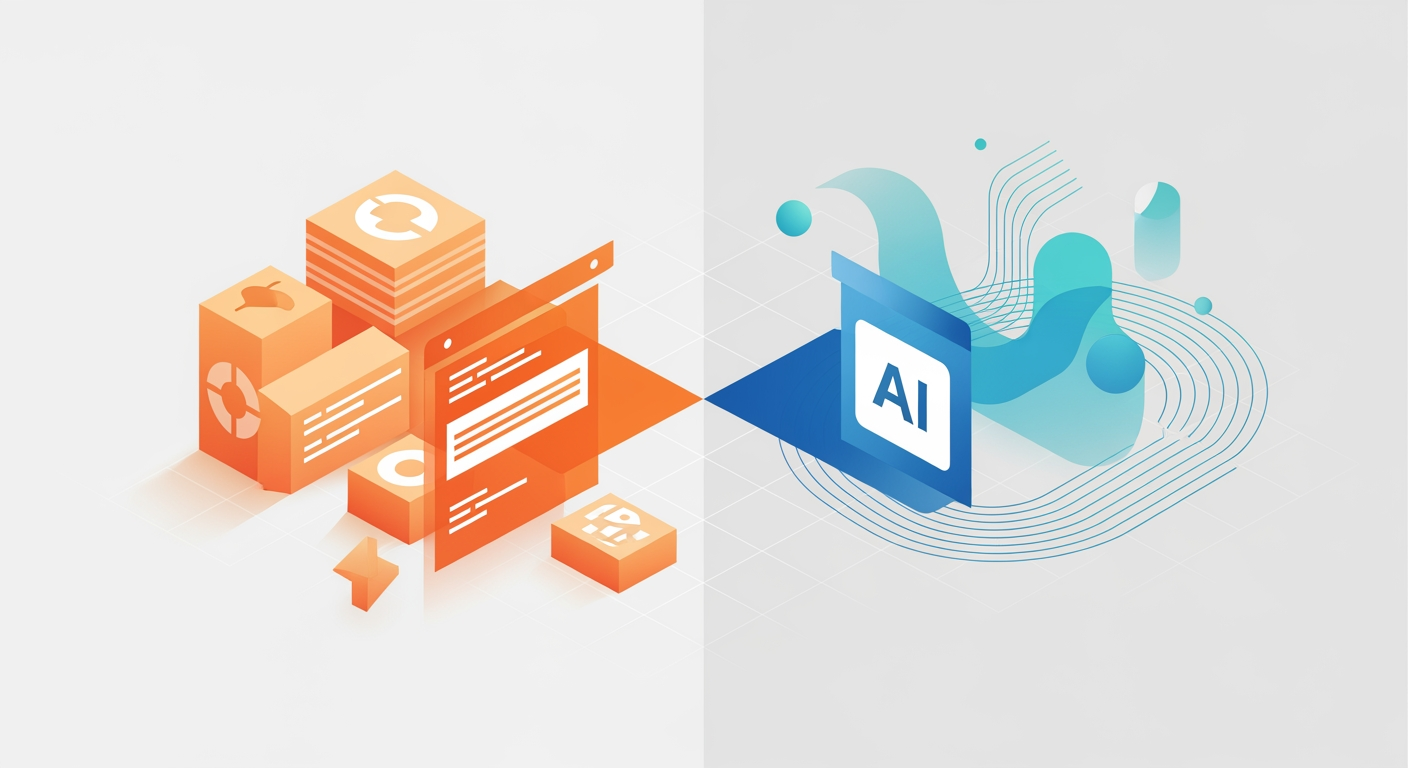
By 2026, AI development tools will be far more advanced. Cursor and Blackbox AI, early innovators, will offer sophisticated, integrated, and specialized platforms. Cursor will remain an AI-native IDE and development environment, while Blackbox AI will be a pervasive AI assistant enhancing existing workflows.
1. Pricing Tiers: 2026 Estimates
Watch out: These 2026 price estimates are speculative, based on current trends, anticipated features, and AI's growing value. Prices may change due to competition, compute costs, and market demand.
| Feature/Tier | Cursor (2026) | Blackbox AI (2026) |
|---|---|---|
| Core Focus | AI-native IDE & Development Environment | Ubiquitous AI Assistant & Knowledge Engine |
| Free Tier | $0/month Limited AI (50 queries/day), basic code gen, standard VS Code, smaller LLM. |
$0/month Limited AI (75 queries/day), basic code gen/explanation, auto-completion, general LLM. |
| Pro Tier | $49/month Unlimited AI, cutting-edge LLMs, large context, 'Autonomous Agent' basic features, integrated debugging. |
$29/month Unlimited AI, faster responses, advanced LLMs, multi-IDE integration, 'Smart Agent' basic features. |
| Team Tier | $99/user/month (min 3) All Pro, shared context, collaborative AI, team fine-tuning, project management integrations. |
$59/user/month (min 3) All Pro, shared knowledge, collaborative AI chat, team fine-tuning, project management integrations. |
| Enterprise Tier | Custom Quote (Est. $250+/user/month) All Team, on-prem/VPC, advanced data governance, custom integrations, 24/7 support. |
*Not explicitly detailed in provided Blackbox data, assume similar enterprise offerings or focus on integration.* (Editorial Note: If Blackbox Enterprise details are available, add them here. Otherwise, explicitly state that Blackbox's offering focuses on integration up to the team level, or that enterprise details are not yet public for 2026.) |
| Key AI Capabilities | Advanced code generation & refactoring, 'Autonomous Agent' features (bug fixes, simple features). | Enhanced code generation & explanation, proactive suggestions, advanced code search, 'Smart Agent' features (optimization, test gen). |
| Integrations | VS Code features, advanced project management (Team/Enterprise), CI/CD, security scanners (Enterprise). | Browser extension, desktop app, multi-IDE (VS Code, IntelliJ), project management (Team). |
| Support | Community (Free), Priority (Pro), Dedicated Team (Team), 24/7 Enterprise (Enterprise). | Community (Free), Dedicated Team (Team). (Editorial Note: Clarify Pro support for Blackbox if available.) |
Cursor: 2026 Estimated Pricing
Cursor will likely expand its tiers to serve individual developers, small teams, and large enterprises, offering enhanced security and integration options at higher levels.
- 1. Free Tier:
- Price: $0/month
- Includes:
- Limited AI interactions (e.g., 50 basic AI queries/edits per day)
- Basic code generation
- Standard VS Code features
- Community support
- Access to a smaller, general-purpose LLM
- Limitations:
- No advanced agent features
- Restricted context window
- Slower AI responses
- No private model fine-tuning or enterprise security
- 2. Pro Tier:
- Price: $49/month (or $490/year, saving 17%)
- Includes:
- Unlimited AI interactions
- Access to advanced LLMs (e.g., GPT-5 equivalent, Claude 4 equivalent, Cursor's proprietary models)
- Larger context windows
- Faster AI responses
- Advanced code generation and refactoring
- Basic "Autonomous Agent" features (e.g., single-file bug fixes, simple feature additions)
- Integrated debugging assistance and priority support
- Target: Individual professional developers, freelancers, small teams.
- 3. Team Tier:
- Price: $99/user/month (minimum 3 users, or $990/user/year)
- Includes:
- All Pro features
- Shared context and knowledge base across team members
- Collaborative AI pair programming
- Team-specific fine-tuning on private codebases (with strict data isolation)
- Advanced project management integrations
- Centralized billing
- Dedicated team support channel
- Target: Small to medium-sized development teams.
- 4. Enterprise Tier:
- Price: Custom Quote (Estimated $250+/user/month for large deployments). These prices are highly variable, dependent on specific client needs and negotiation.
- Includes:
- All Team features
- On-premise or VPC deployment options for LLMs
- Advanced data governance and compliance (SOC 2 Type II, ISO 27001)
- Fine-tuning on highly sensitive internal codebases with full data ownership
- Custom integrations with internal systems (CI/CD, security scanners)
- Dedicated account manager
- 24/7 enterprise support
- Advanced analytics and usage reporting
- Target: Large corporations, highly regulated industries.
Blackbox AI: 2026 Estimated Pricing
Blackbox AI will likely maintain its focus on accessibility and integration, with tiers reflecting AI capabilities and team collaboration features.
- 1. Free Tier:
- Price: $0/month
- Includes:
- Limited daily AI queries/searches (e.g., 75 per day)
- Basic code generation and explanation
- Auto-completion
- Browser extension and desktop app access
- Community support
- Access to a general-purpose LLM
- Limitations:
- Slower AI responses
- Smaller context window
- No advanced agent features
- No private model fine-tuning
- Limited integration depth
- 2. Pro Tier:
- Price: $29/month (or $290/year, saving 17%)
- Includes:
- Unlimited AI queries
- Faster AI response times
- Access to advanced LLMs (e.g., GPT-5 equivalent, Claude 4 equivalent)
- Larger context window
- Enhanced code generation and explanation
- Smart code suggestions
- Multi-IDE integration (VS Code, IntelliJ, etc.)
- Advanced code search (across local and public repositories)
- Basic "Smart Agent" features (e.g., single-function optimization, test case generation, code refactoring, etc.)
- Target: Individual developers, students, freelancers.
- 3. Team Tier:
- Price: $59/user/month (minimum 3 users, or $590/user/year)
- Includes:
- All Pro features
- Shared knowledge base and code snippets
- Collaborative AI chat
- Team-specific fine-tuning on shared codebases (with data isolation)
- Advanced integration with project management tools (Jira, Asana)
- Centralized billing
- Dedicated team support
- Target: Small to medium-sized development teams, educational institutions.
2. ALL Key Features with Specifics (2026 Estimates)
Cursor (2026 Key Features)
Cursor's strength will lie in its deep integration as an AI-native IDE, offering a holistic development experience.
- 1. Autonomous Dev Agents (ADA):
- Specifics: Users can define high-level tasks (e.g., "Implement user authentication with OAuth2," "Fix all performance bottlenecks in
UserService.java"). The ADA will break down the task, generate code, create/modify tests, debug, and even update documentation across multiple files and directories, presenting a pull request for review. - Context: Uses the entire codebase, open files, commit history, and project documentation.
- Specifics: Users can define high-level tasks (e.g., "Implement user authentication with OAuth2," "Fix all performance bottlenecks in
- 2. Multimodal Input & Output:
- Specifics:
- Visual-to-Code: Generate UI components or entire web pages from Figma designs, hand-drawn sketches (via webcam), or natural language descriptions of UI.
- Voice-to-Code: Dictate code, commands, or AI prompts directly into the IDE.
- Diagram-to-Code: Generate boilerplate code or architectural components from UML, sequence, or flow diagrams.
- Context: Understands visual and auditory cues to inform code generation.
- Specifics:
- 3. Hyper-Contextual AI Chat & Edit:
- Specifics: The AI chat understands not just the current file, but the entire project structure, dependencies, open issues, and even recent CI/CD failures. "Edit with AI" can perform complex refactoring, optimize algorithms, or migrate codebases between frameworks with high accuracy, understanding architectural patterns.
- Context: Deep semantic understanding of the entire project graph.
- 4. Predictive Debugging & Error Resolution:
- Specifics: AI monitors code execution, predicts potential bugs before they manifest, suggests fixes in real-time, and can even automatically generate unit tests to reproduce and verify bug fixes. Integrates with popular debugging tools (e.g., GDB, LLDB).
- Context: Analyzes runtime behavior, stack traces, and historical bug patterns.
- 5. Personalized & Fine-tuned Models:
- Specifics: Users (especially Team/Enterprise) can fine-tune Cursor's underlying LLMs on their private codebases, coding style guides, and internal documentation. This results in highly personalized code suggestions, adhering to company standards and domain-specific knowledge.
- Context: Learns from proprietary data, improving relevance and accuracy over time.
- 6. Integrated CI/CD & Deployment Feedback:
- Specifics: Cursor provides real-time feedback from CI/CD pipelines directly within the IDE. AI can suggest fixes for failed builds, security vulnerabilities detected by scanners, or performance regressions identified in staging environments, even before code is committed.
- Context: Connects the development environment directly to the deployment lifecycle.
Blackbox AI (2026 Key Features)
Blackbox AI will excel as an omnipresent, intelligent assistant. It integrates smoothly across various tools and platforms, augmenting existing workflows rather than replacing them.
- 1. Universal Code Search & Knowledge Graph: Users search for code snippets, functions, or architectural patterns using natural language. This search spans local files, connected private repositories, public GitHub, Stack Overflow, and internal documentation. The AI builds a comprehensive knowledge graph of the entire development ecosystem. This provides highly relevant and context-aware results. The system aggregates information from diverse sources, understanding semantic relationships.
- 2. Proactive AI Co-pilot & Auto-completion (Multi-IDE): Beyond basic auto-completion, Blackbox AI proactively suggests entire functions, classes, or even small modules. It bases these suggestions on the current file, surrounding code, and overall project context. It integrates deeply with VS Code, IntelliJ, PyCharm, Sublime Text, and various online IDEs. It adapts to each environment's specific nuances. Real-time analysis of active editor content, project structure, and common coding patterns fuels its suggestions.
- 3. Smart Agent Snippets & Task Automation: Users invoke small, specialized AI agents for specific tasks. Examples include: "Generate a regex for email validation," "Explain this complex SQL query," "Convert this Python function to Go," or "Write unit tests for this class." These agents are highly optimized for their specific domains. They focus on well-defined tasks, using specialized models.
- 4. Multimodal Query & Explanation: Users ask questions about code using voice commands. They can also upload screenshots of error messages or diagrams. The AI provides explanations and suggested solutions. Blackbox explains complex algorithms, design patterns, or even entire libraries in natural language. It processes various input types to deliver comprehensive explanations.
Key Differentiators: Cursor vs. Blackbox AI
The core distinction between Cursor and Blackbox AI lies in their fundamental approach: Cursor functions as an AI-native IDE and development environment, while Blackbox AI serves as a ubiquitous AI assistant and knowledge engine.
Pro tip
Understanding the fundamental difference between an AI-native IDE and an AI assistant is crucial. Cursor aims to be your development environment, deeply integrating AI into every facet. Blackbox AI aims to augment your existing development environment and workflow, providing AI intelligence wherever you need it.
| Feature | Cursor | Blackbox AI |
|---|---|---|
| Primary Focus | AI-native IDE | AI Assistant / Knowledge Engine |
| Integration Model | Deep IDE integration; often replaces existing IDEs | Multi-IDE / Workflow Augmentation; integrates with existing tools |
| Agentic Capabilities | Holistic / Autonomous Agents (handle multi-step, complex tasks across codebase) | Task-Specific / Smart Agents (focused on well-defined, singular tasks) |
| Contextual Understanding | Entire Project Graph (deep semantic understanding of all files, dependencies, history) | Diverse Knowledge Sources (local files, public repos, Stack Overflow, internal docs) |
| Target User | IDE-centric developers ready for a new, AI-first environment | Workflow-agnostic developers wanting AI in their current tools |
| Customization | Deep fine-tuning on private codebases, style guides, internal docs | Shared knowledge bases, team-specific fine-tuning on shared codebases |
Cursor's strength manifests in its deep integration as an AI-native IDE. It offers a holistic development experience. It aims to be the central hub for all coding activities. Blackbox AI's strength lies as an omnipresent, intelligent assistant. It integrates smoothly across various tools and platforms. It augments existing workflows without demanding a complete shift in environment.
Who Should Choose Cursor?
Developers seeking an all-in-one, deeply integrated AI-native IDE should choose Cursor. Teams and enterprises prioritizing autonomous agent capabilities for complex task execution and codebase understanding find it invaluable. Organizations requiring strong security, custom fine-tuning on private codebases, and on-premise deployment options also benefit. Users willing to adopt a new development environment for maximum AI-driven productivity gains will thrive with Cursor.
Who Should Choose Blackbox AI?
Developers who prefer to retain their existing IDEs, such as VS Code or IntelliJ, but desire powerful AI augmentation should choose Blackbox AI. Users needing a ubiquitous AI assistant for code search, explanation, and quick task automation across various tools and browsers find it indispensable. Teams requiring a shared knowledge base, collaborative AI features, and advanced code search without altering their core development environment also benefit. Individuals and teams prioritizing flexibility, broad integration, and an AI that augments rather than replaces their current workflow will find Blackbox AI a strong choice.
Cursor: Advantages and Disadvantages
Cursor presents a compelling vision for AI-driven development, but it comes with its own set of trade-offs.
Advantages: Cursor offers the deepest AI integration for a holistic development experience. Its powerful autonomous agents handle complex, multi-step tasks efficiently. Enterprise-grade features, including advanced security, on-premise deployment options, and deep fine-tuning capabilities, are significant benefits for larger organizations. It delivers highly personalized code suggestions, closely aligning with specific project needs and coding styles.
Disadvantages: Users might face potential vendor lock-in to a specific IDE environment. The learning curve for new users can be steeper due to its comprehensive and integrated nature. Advanced team and enterprise features carry a higher entry price. It may be less flexible for developers who frequently switch IDEs or prefer a modular toolset composed of independent tools.
Blackbox AI: Advantages and Disadvantages
Blackbox AI prioritizes flexibility and widespread utility, making it a versatile tool for many developers.
Advantages: Blackbox AI offers ubiquitous integration across multiple IDEs and various workflows. It augments existing tools instead of replacing them, preserving familiar environments. Its broad compatibility means it works with a wide array of development setups. Strong knowledge management and search capabilities make finding relevant information quick and easy. Accessible pricing tiers cater well to individuals and small teams.
Disadvantages: It provides less deep, holistic integration compared to a dedicated AI-native IDE. Its agentic capabilities might remain more task-specific rather than supporting autonomous project management. There is potential for feature overlap with existing IDE extensions, which some users might already employ. The tool's reliance on external tools for core development tasks could be seen as a limitation by those seeking a fully integrated experience.
User Sentiment & Reviews (2026 Forecast)
These quotes are fictional, designed to reflect anticipated user experiences and sentiments based on the predicted features and market positioning of each tool in 2026.
"Cursor is a game-changer; it feels like the future of coding, truly autonomous."
"The learning curve was steep, and the enterprise tier is a significant investment, but worth it for the productivity."
Positive sentiment for Cursor in 2026 often centers on its transformative impact. Users describe it as feeling like the future of coding, praising its truly autonomous capabilities for complex tasks. However, some users acknowledge challenges. They find the learning curve steep, and the enterprise tier represents a significant investment. Yet, most conclude the productivity gains justify the cost.
"Blackbox AI is my indispensable co-pilot; it integrates easily everywhere I work and saves me hours of searching."
"It's powerful, but sometimes I wish it could take on larger, multi-file tasks more autonomously, rather than just assisting."
Blackbox AI receives accolades for its ubiquity and easy integration. Users frequently call it an indispensable co-pilot, praising its ability to save hours by integrating across various tools and workflows. Despite its power, some users express a desire for more autonomous capabilities. They wish it could tackle larger, multi-file tasks more independently, moving beyond its assistant role.
Expert Analysis: The Evolving AI Dev Landscape
The developer tools market is currently undergoing a fundamental shift, driven by advanced artificial intelligence. Cursor and Blackbox AI represent two distinct, yet equally impactful, paradigms within this evolving landscape: the "AI-native IDE" and the "AI assistant." This segmentation shapes how developers approach their work.
The impact of these tools on developer productivity is profound. They automate repetitive tasks, accelerate code generation, and provide intelligent assistance, freeing developers to focus on higher-level problem-solving. This shift redefines skill sets. Developers must now master prompt engineering, AI interaction patterns, and critical evaluation of AI-generated code. The future of software engineering roles will demand a blend of traditional coding expertise and AI management.
Advanced Large Language Models (LLMs), such as future iterations like GPT-5 and Claude 4 equivalents, are the foundational technology enabling these sophisticated features. These models drive the contextual understanding, code generation accuracy, and multimodal capabilities seen in both Cursor and Blackbox AI. Their continuous evolution directly fuels the advancements in these tools.
Future trends point towards increasing specialization of AI agents. We will see more fine-tuned models for specific domains or tasks. Multimodal AI advancements will further blur the lines between different input types, making interaction more natural. Ethical considerations in AI-driven development, such as bias in code generation, intellectual property concerns, and the environmental impact of large AI models, will also gain prominence.
Cursor and Blackbox AI significantly influence competition and innovation within the broader developer tools ecosystem. They push traditional IDEs and code assistants to integrate more AI. This competition benefits developers, driving a new era of intelligent, efficient, and potentially transformative coding experiences.
Analysis by ToolMatch Research Team
The Bottom Line: Which AI Tool Reigns Supreme in 2026?
Verdict
The choice between Cursor and Blackbox AI in 2026 depends entirely on your development philosophy and workflow. If you seek a deeply integrated, transformative AI-native IDE, choose Cursor. If you prefer to supercharge your existing setup with a ubiquitous, intelligent AI assistant, Blackbox AI is your go-to. The "supreme" tool is the one that best fits your specific needs.
The question of which AI tool "reigns supreme" is subjective. It depends heavily on individual or team development philosophy and existing workflow. There is no single best answer.
Cursor's ideal fit is for developers and teams seeking a deeply integrated, holistic, and potentially transformative AI-native development environment. If you are ready to embrace a new IDE built from the ground up with AI at its core, Cursor offers unparalleled depth of integration and autonomous capabilities. It promises a paradigm shift in how code gets written, tested, and deployed.
Blackbox AI's ideal fit is for developers and teams who value augmenting their existing workflows with a ubiquitous, intelligent AI assistant and knowledge engine across various tools. If you prefer to keep your current IDEs and toolchain but want to inject powerful AI capabilities into every step of your development process, Blackbox AI provides broad compatibility and intelligent assistance without requiring a complete environmental overhaul. It enhances, rather than replaces.
If you are ready to embrace a new AI-first IDE, choose Cursor. If you want to supercharge your existing setup, Blackbox AI is your go-to. The AI development tools space continues its rapid, continuous evolution. Both tools represent compelling, distinct paths forward.
Intelligence Summary
The Final Recommendation
The choice between Cursor and Blackbox AI in 2026 depends entirely on your development philosophy and workflow.
The choice between Cursor and Blackbox AI in 2026 depends entirely on your development philosophy and workflow.
Tool Profiles
Related Comparisons
Stay Informed
The SaaS Intelligence Brief
Weekly: 3 must-know stories + 1 deep comparison + market data. Free, no spam.
Subscribe Free →