Cursor vs Cody
Detailed comparison of Cursor and Cody — pricing, features, pros and cons.
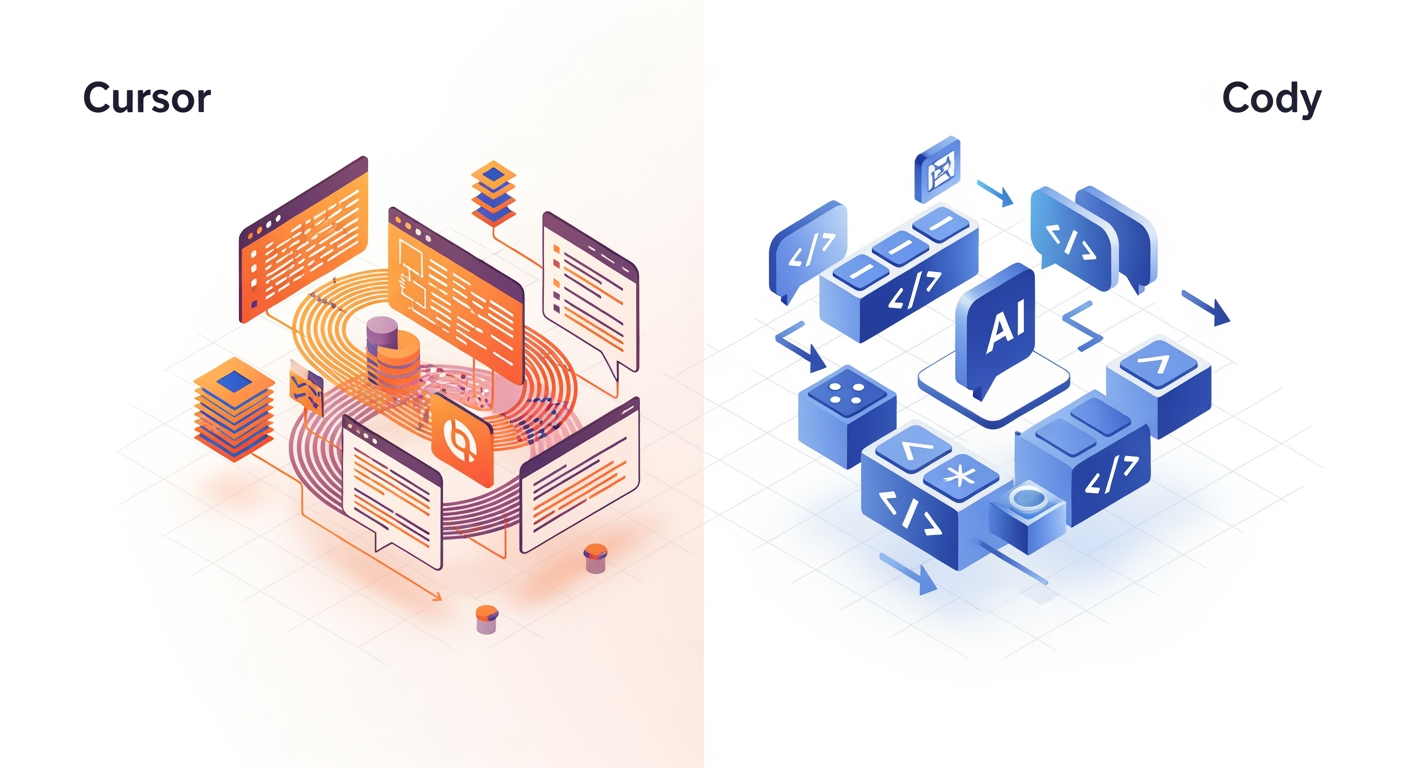
The Challenger
Cody
Best for AI Coding
The Quick Verdict
Choose Cursor for a comprehensive platform approach. Deploy Cody for focused execution and faster time-to-value.
Independent Analysis
Feature Parity Matrix
| Feature | Cursor from $20/mo | Cody |
|---|---|---|
| Pricing model | freemium | freemium |
| free tier | ||
| api access | ||
| ai features | ||
| integrations | VS Code extensions |
Cursor: The AI-Native IDE in 2026
Analysis by ToolMatch Research Team
By 2026, AI will be central to coding. Cursor, an AI-native IDE, fundamentally changes development workflows, offering a new, essential coding experience for developers.Who Should Choose Cursor: The AI-Native IDE Advocate
Pro tip
Cursor best serves developers ready to adopt an environment where AI drives every interaction from concept to deployment.
Cursor's Distinctive Approach
Cursor builds AI directly into the development environment.| Aspect | Cursor (AI-Native IDE) |
|---|---|
| Core Philosophy | AI-native IDE, integrated experience. |
| Integration Approach | Native IDE. AI is woven into the environment. |
| Context Understanding | Deep IDE-native, project-wide understanding with 1M+ token context. AI understands the entire codebase intimately. |
| Feature Focus | Agent-driven, full development lifecycle. Emphasizes agents, debugging, varied input/output. |
| Pricing Model Philosophy | Premium, integrated experience. Tiers for individuals, teams, and custom enterprise solutions with increasing AI power and features. |
| Target User Preference | Willingness to adopt a new, AI-first IDE for transformed workflow. |
Cursor's Edge: Beyond Traditional IDEs
Cursor establishes itself as a true AI-native IDE. Its core philosophy differs from traditional IDEs that add AI features. Cursor builds AI into every fabric of the experience, from project setup to deployment. This deep integration allows for agent architectures and direct assistance. It pushes the boundaries of what a development environment can achieve. Cursor's deep context understanding, exemplified by the 1M+ token window, creates a profound shift in developer interaction. This integrated model could lead to self-healing code and highly autonomous development cycles.Feature Deep Dive: Unpacking Cursor's AI-Native Toolkit
Cursor offers many AI-native features. AI-Native Code Generation & Completion offers varied input assistance. It generates entire functions, classes, and even small features based on natural language prompts, existing code, and project context. Predictive completion anticipates your needs, suggesting not just lines, but entire blocks of code, API calls, and test cases *before* you even type the first character. It learns your coding style and project patterns, even supporting multimodal input like "build a UI component like this Figma sketch." Autonomous Agent Workflows empower developers. Users define high-level tasks—such as "Implement user authentication with OAuth2" or "Add a new endpoint for product reviews"—and Cursor's agents autonomously break them down. They generate code, create tests, identify dependencies, and even suggest refactors, delivering a pull request-ready solution. Users retain full oversight, able to supervise and intervene at any stage. Predictive Debugging & Error Resolution anticipates problems. The AI actively monitors code execution, identifying potential bugs *before* they manifest. It suggests fixes, generates new test cases to prevent recurrence, explains complex error messages in plain language, and proposes solutions based on common patterns and project history. Project-Wide Semantic Understanding maintains a real-time, semantic understanding of the entire codebase, documentation, and even related tickets/specs. This allows AI to answer complex questions, generate highly relevant code, and perform refactoring operations that span multiple files and modules with high accuracy. Multimodal Input & Output supports natural language, code, diagrams, screenshots, and voice commands. AI outputs not just code, but also architectural diagrams, basic UI mockups, and documentation snippets. Smart Refactoring & Code Quality Agents move beyond basic refactoring. They identify code smells. They suggest architectural improvements. They optimize performance. They ensure standard adherence, automatically applying changes with user approval. AI-Driven Test Generation & Coverage automatically generates unit, integration, and even end-to-end tests. It bases tests on code changes and feature descriptions. It analyzes test coverage and suggests new tests for uncovered areas. Personalized Learning & Style Adaptation molds AI suggestions. It learns individual developer preferences, coding style, preferred libraries, and common patterns, adapting its suggestions and generations to match. It can also onboard new developers by providing context-aware explanations of the codebase. Integrated Version Control & AI-Powered PRs assists with commit messages. It reviews code changes. It suggests pull request improvements. It automatically resolves merge conflicts.Pricing Models: A Cost-Benefit Analysis of Cursor
Watch out: Cursor's advanced AI features can demand significant local computing resources. Ensure your hardware can keep pace, or factor in potential upgrade costs.
Cursor's Strengths and Weaknesses: The AI-Native IDE's Edge
Cursor offers compelling advantages, but also presents considerations. Its design prioritizes AI-first development. Pros: Cursor delivers Unmatched Productivity. Its AI-first design provides the most integrated AI experience possible. It boasts the Deepest Contextual Understanding. Native IDE architecture allows unparalleled project-wide understanding, leading to highly accurate and relevant AI suggestions. Cursor introduces Cutting-Edge AI Features. It often leads the market with advanced capabilities like agents, debugging, and varied interactions. It creates a Streamlined Workflow. AI integration directly into every aspect of the IDE reduces context switching from coding to testing to deployment. Personalization adapts to individual developer styles, preferred libraries, and project specifics, making the AI feel truly bespoke. Cursor holds Potential for Radical Innovation. By rethinking the IDE from its foundation, Cursor can introduce entirely new paradigms for software development. Cons: Cursor can create Vendor Lock-in. Committing to Cursor means adopting their entire IDE, which represents a significant shift for developers accustomed to other environments. It is Resource Intensive. Running advanced AI models and maintaining deep project context can demand significant local computing power and cloud resources. A Learning Curve exists. While intuitive for basic use, fully utilizing its agent features requires adapting to a new way of interacting with code. Potential for AI Hallucinations in Critical Path remains. Despite advancements, AI can still generate incorrect or suboptimal code, requiring diligent human oversight, especially with agents. Cost is a factor; premium features and enterprise solutions can be significantly more expensive than traditional IDEs or AI extensions. Its Limited Plugin Ecosystem might lag behind the decades-old established IDEs like VS Code or JetBrains, potentially requiring workarounds for niche tools.What Developers Are Saying: Real-World Experiences with Cursor
Developer feedback paints a vivid picture of Cursor's impact. Users describe transformative experiences."Cursor 2026 is an absolute game-changer. It's not just an assistant; it's like having a senior architect and a super-fast junior dev rolled into one. The autonomous agents for feature implementation are mind-blowing. My productivity has easily doubled."
Expert Analysis: Strategic Positioning and Future Trajectories
Cursor occupies a distinct strategic position. It targets a specific facet of the evolving AI coding market. Cursor holds a strategic advantage as an AI-native IDE. It redefines the development workflow by embedding AI at its core. This approach allows for agent architectures and direct assistance. It pushes the boundaries of what a development environment can achieve. Its deep context understanding, exemplified by the 1M+ token window, creates a profound shift in developer interaction. This integrated model could lead to self-healing code and highly autonomous development cycles. The market trends toward varied interaction and agent architectures. Cursor drives innovation by building these from the ground up within its IDE. It aims to bring these capabilities to developers. The choice between deep, native context versus broad compatibility shapes developer adoption. Cursor demands a change. Long-term viability depends on continued innovation and addressing its challenges. Cursor must broaden its plugin ecosystem.The Bottom Line: Choosing Your AI Coding Partner in 2026
Choosing Cursor requires understanding your priorities. It offers powerful AI capabilities for 2026 development. Cursor excels through deep integration. Its agent workflows and AI-first productivity transform the coding experience. It suits developers who want to fully embrace a new, AI-centric approach. If you seek productivity gains and accept a new IDE, Cursor is your choice. It accelerates feature delivery. It streamlines workflows. It is ideal for individuals, startups, and teams targeting innovation. For large enterprises with strict security, its Enterprise Tier provides on-premise solutions. Individual developers must weigh the commitment to a new IDE. Enterprises consider security, fine-tuning, and integration with vast, proprietary codebases. Your decision rests on your appetite for change and the depth of AI integration you require.Intelligence Summary
The Final Recommendation
Choose Cursor for a comprehensive platform approach.
Deploy Cody for focused execution and faster time-to-value.
Tool Profiles
Related Comparisons
Stay Informed
The SaaS Intelligence Brief
Weekly: 3 must-know stories + 1 deep comparison + market data. Free, no spam.
Subscribe Free →